
Provider sources
Compare
Why CoderFriend AI
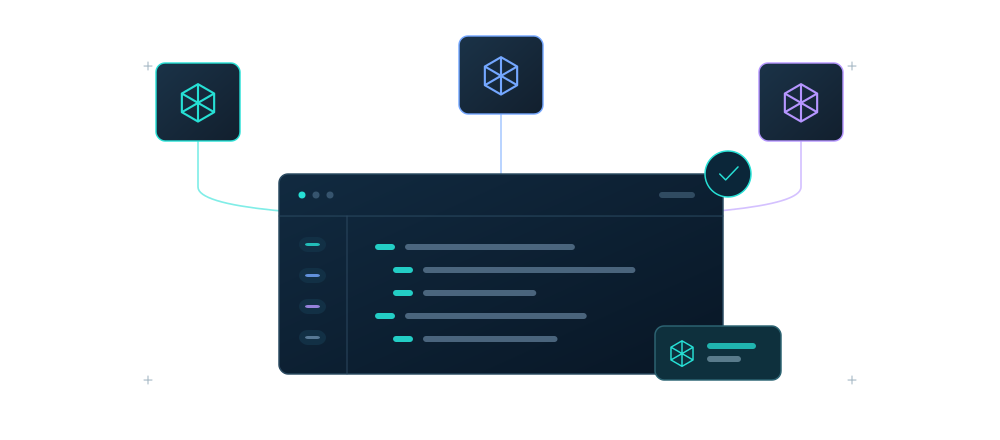
Every model you already pay for, in one editor.
Connect to eleven provider sources—including the ChatGPT and Claude subscriptions you already have. Bring your own access, choose the model for the task, and pay your provider directly.
Built-in telemetry
Provider cost reporting
Your workflow, your choice
Bring more of what you already use.
One editor for your models, your subscriptions, and your project.
Bring your own everything.
API keys, local Ollama, or a subscription you already pay for. Sign in to Claude Code or Codex once and reuse that session without a second AI-usage invoice or an API key.
The agent must prove it.
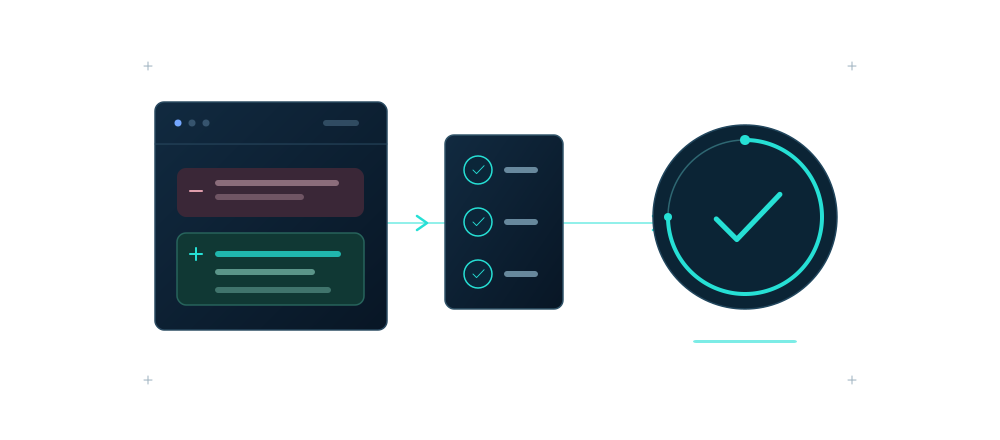
Completion requires a workspace change and a passing check behind it. Safeguards track the evidence and explain when a task cannot be marked finished.
No built-in telemetry.
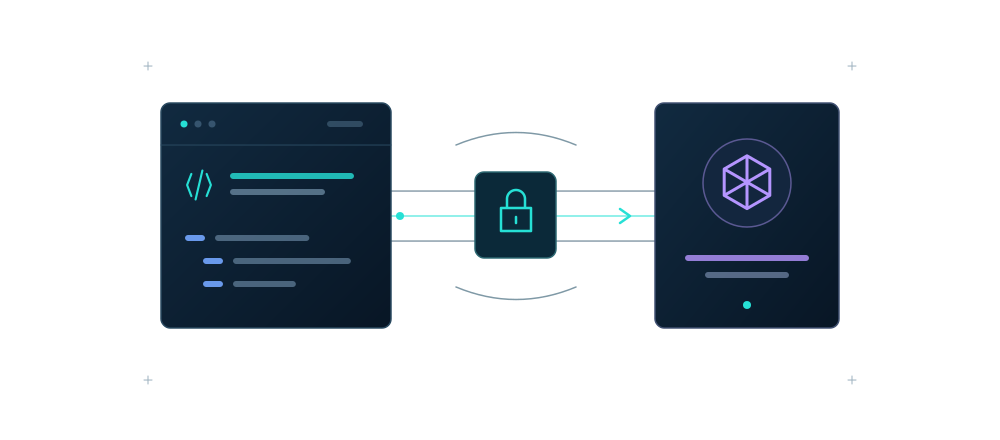
CoderFriend AI sends no analytics or advertising telemetry. Requests go to your chosen provider. Costs use the provider’s own numbers, or show N/A when unavailable.
Side by side
How the approaches differ.
Compare who you pay, what you control, and how work is verified.
Swipe or scroll horizontally to see every approach.
| What matters | CoderFriend AI | Vendor-bundled assistant | Hosted multi-model tool | Open BYOK extension |
|---|---|---|---|---|
| Who you pay | Your provider directly. No inference markup or message quota added by CoderFriend AI. | The vendor, for their own models. | The tool, which buys inference and resells it. | The provider, directly. |
| Model choice | Twelve sources side by side, switchable mid-conversation. | One family. | A curated set the tool supports. | Usually several, by API key. |
| Existing subscriptions | Reused — a Claude Pro/Max or ChatGPT sign-in works with no API key. | Its own subscription only. | Rarely; the tool bills you. | Typically API keys only. |
| Telemetry | No built-in analytics or advertising telemetry. | Usually collected. | Usually collected. | Varies by project. |
| Cost reporting | Exact, or N/A. Never estimated. | Seat price; per-request cost usually hidden. | Credits or requests, not provider cost. | Varies; often estimated from token counts. |
| Agent completion | Refused without a mutation and a passing check behind it. | The model reports done. | The model reports done. | The model reports done. |
| Command execution | Sandboxed commands with task-specific approvals and trust profiles that control access. | Varies. | Often a remote container. | Frequently an unguarded shell. |
| Verifying its own work | Checks pages through browser interactions, screenshots, and console/network inspection. | Rarely. | Sometimes, remotely. | Rarely. |
| Where code goes | Your machine and your chosen provider. No CoderFriend AI relay. | The vendor. | The tool's servers, then a provider. | Your chosen provider. |
| Administrator control | Administrator policies can restrict user-approved permissions and enforce approved key sources. | Enterprise plan. | Enterprise plan. | Usually none. |
These columns describe general approaches, not audited claims about named products. Individual tools and plans vary. Provider subscription limits and charges still apply.
Evidence before completion
What happens when the model is wrong?
An agent that edits files needs checks around its work. These safeguards explain refusals and keep unfinished work visible.
Completion evidence
A task cannot be marked done without a workspace change followed by a passing project check.
Verification state
An unchanged check is not re-run, and a failed one is not quietly forgotten.
Mutation progress
An edit that adds a file nothing imports is scaffolding, not progress, and is named as such.
Read-stall pacing
A run that reads without acting is nudged, then stopped, before it reads the repository forever.
Repeated failure
The same command failing the same way twice is reported, so the model stops rewording it.
Claim consistency
A report claiming a reversal over a diff that only added lines is flagged against its own diff.
Task dependencies
A task cannot close while the work it depends on is unfinished.
Checkpoints
Every mutation is attributable, cancellable, reviewable, and restorable.
Before you install
Know the trade-offs.
Choose the workflow that fits the way you want to work.
AI usage is separate.
Use a provider key, local Ollama, or an existing ChatGPT or Claude sign-in. A vendor-bundled tool may suit you better if you want one bill that includes AI usage.
Runs on your machine.
Agent work happens locally in your editor. Closing the laptop stops the run; CoderFriend AI does not host the agent in the cloud.
Windows sandboxing is still developing.
macOS and Linux enforce command boundaries. Windows command isolation is not yet at parity; the limitation is shown before unsandboxed commands are enabled.
Team administration is early.
Machine-level policy and enforced key sources are available. Shared skills, roles, and organization retention are still being built.
Who it suits
Keep your subscriptions. Choose your workflow.
For developers who already pay for a model subscription, want to switch models in the same conversation, and expect evidence when an agent says the work is finished. For teams that want requests to go directly to the chosen provider.